

 Product
 Brand
Brand Articles
 Tools
Tools
Amp Limiter Circuit: Complete Guide, Specs, and Applications
Quick Answer
An amp limiter circuit prevents an amplifier's output from exceeding a set voltage, current, or power level. When the signal stays below the threshold, the limiter is effectively invisible; when the signal tries to pass it, the circuit clamps or attenuates the excess. The two main families are voltage limiters (clippers), which cap signal amplitude, and current limiters, which throttle output current to protect the amplifier and its load from overloads and short circuits. Common implementations range from a two-diode clipper costing a few cents to op-amp feedback limiters, transistor current limiters, and VCA-based audio limiters used in professional sound systems.
Which topology you need depends on one question: are you protecting against voltage peaks (distortion, downstream overload, speaker damage) or excess current (shorts, thermal failure)? This guide covers both, with the specs that matter, worked sizing logic, and the mistakes that show up most often in real builds.
What an Amp Limiter Circuit Is — and What It Is Not
A limiter is a nonlinear circuit that enforces a ceiling. Below the threshold it should pass the signal unchanged; above it, the output stops tracking the input.
It helps to separate three things people often mix together:
Voltage limiter (clipper). Caps the instantaneous amplitude of a signal. Used to protect ADC inputs, op-amp stages, RF front ends, and speakers from peaks they cannot handle.
Current limiter. Caps the current an output stage or supply can deliver. Unlike a fuse, an active current limiter does not need replacement after a fault — it throttles the pass element and recovers automatically once the overload clears.
Audio limiter (dynamic limiter). A gain-control circuit, essentially a compressor with a very high ratio. Instead of clipping the waveform, it turns the gain down when the level crosses the threshold, which keeps the output clean. This is the type used in PA systems, broadcast chains, and mastering.
A limiter is also not a substitute for everything else in the protection chain. It does not replace a fuse for sustained fault energy, a TVS diode for nanosecond transients, or a thermal cutoff for heatsink failures. Treat it as one layer in a protection strategy, not the whole strategy.
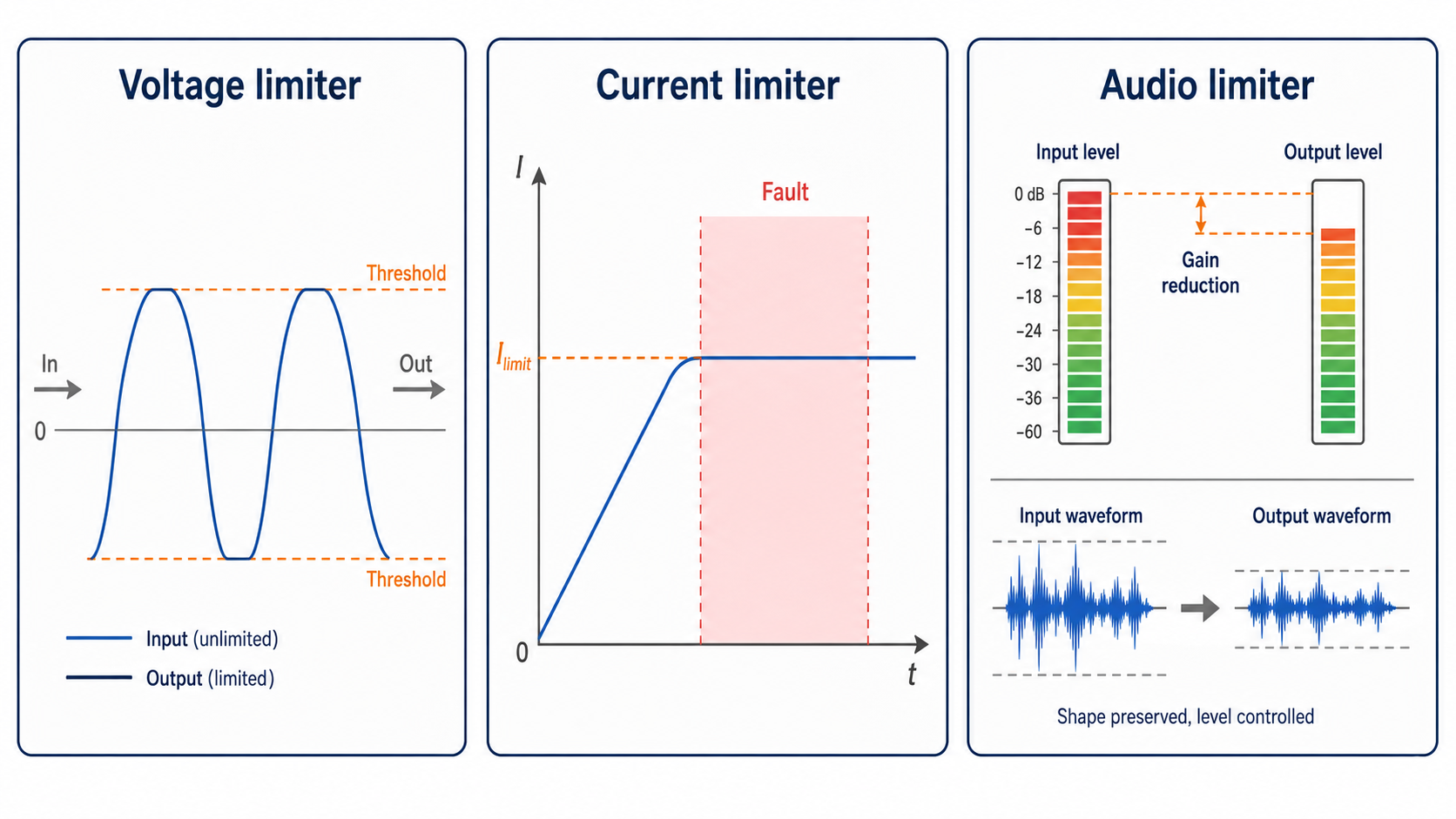
Three limiter families: clamp the voltage, throttle the current, or reduce the gain
The Four Most Common Limiter Topologies
1. Diode Clipper
The simplest voltage limiter: one or two diodes across the signal path. When the signal exceeds the diode's forward voltage — typically around 0.6–0.7 V for silicon — the diode conducts and clamps the excess. Back-to-back diodes clip both polarities.
Strength: Cheap, fast, nearly impossible to get wrong.
Drawback: The threshold is fixed by diode physics, the knee is soft, and clipping above threshold creates significant harmonic distortion.
Best for: Input protection on sensitive stages, RF front ends, and wave shaping where fidelity above threshold does not matter.
2. Op-Amp Feedback Limiter (Zener in the Feedback Loop)
Placing back-to-back Zener diodes (or a Zener bridge) in an op-amp's feedback path produces a precision limiter. The output is held to approximately ±(V_Z + V_D), where V_Z is the Zener breakdown voltage and V_D the series diode drop. Below threshold, the op-amp behaves as a normal amplifier; above it, the Zeners conduct and the loop clamps the output.
Strength: Sharp, predictable threshold you choose by selecting the Zener; much cleaner limiting than a bare diode clipper.
Drawback: Threshold accuracy depends on Zener tolerance and temperature drift; the op-amp must recover quickly from clamping.
Best for: Protecting ADC and DAC inputs, instrumentation chains, and any stage where a precise amplitude ceiling matters.
Classic op-amp application references such as TI's AN-20 applications guide and Analog Devices' Amplifier Applications Guide cover the underlying feedback techniques in depth and are worth reading before committing to component values.
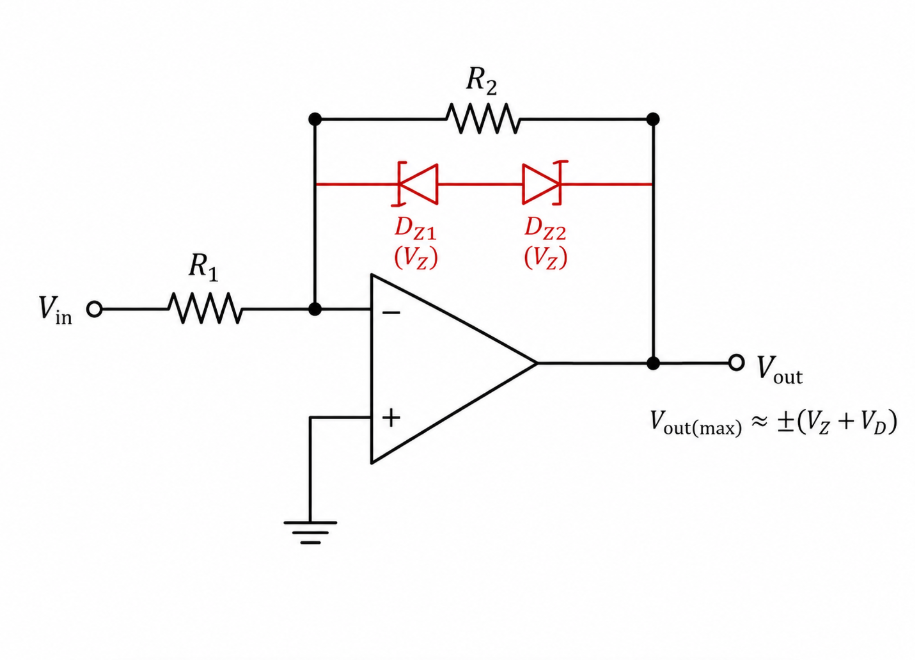
Back-to-back Zeners in the feedback loop clamp the output to roughly ±(V_Z + V_D).
3. Transistor Current Limiter
The textbook active current limiter uses a low-value sense resistor in series with the load plus a small "stealing" transistor. When load current produces about 0.7 V across the sense resistor, the second transistor turns on and diverts base drive away from the pass transistor, capping the current at approximately:
I_limit ≈ 0.7 V / R_sense
So a 0.7 Ω sense resistor limits at roughly 1 A; 0.07 Ω limits at roughly 10 A. The same idea scales to MOSFET pass elements with a comparator or op-amp doing the sensing.
Strength: Self-resetting, fast, two extra components in its simplest form.
Drawback: The 0.7 V threshold drifts with temperature (a V_BE-based threshold changes roughly −2 mV/°C), and the pass transistor dissipates heavily during a sustained fault — it must survive the fault power, not just normal operation.
Best for: Bench supplies, linear regulators, amplifier output stages, LED drivers used as constant-current sources.
4. VCA / Optical / FET Audio Limiter
Professional audio limiters separate the signal path from the control path. A sidechain detector measures the level; when it crosses the threshold, it commands a gain element — a VCA, an LDR-optocoupler pair, or a FET acting as a variable resistor — to reduce gain. The waveform is attenuated, not clipped, so distortion stays low.
Dedicated analog ICs exist for this job. THAT Corporation's DN03 design note, for example, describes a single-chip feedback limiter for power amplifiers built around its 4301 part, combining a gain-control cell with an RMS level detector. Vendor design notes like this are useful for understanding the architecture and verifying feature claims, though performance figures should always be checked against the current datasheet rather than quoted from memory.
Strength: Transparent limiting, adjustable threshold/attack/release, suitable for loudspeaker protection and broadcast compliance.
Drawback: More complex, more expensive, and the attack/release time constants must be tuned to the program material.
Best for: PA systems, powered speakers, broadcast chains, mastering hardware.
Key Specifications to Compare
When evaluating a limiter design or a limiter IC, these are the parameters that actually decide whether it works in your application:
| Specification | What it means | Why it matters |
|---|---|---|
| Threshold | The voltage, current, or level (dB) where limiting begins | Set wrong, the limiter either never protects or constantly chokes the signal |
| Attack time | How fast the limiter engages after a peak appears | Too slow and the first transient gets through; relevant for tweeter and ADC protection |
| Release time | How fast normal gain returns after the peak passes | Too fast causes audible pumping; too slow squashes dynamics |
| Limiting ratio | Output change per input change above threshold | True limiters run roughly 10:1 and higher; lower ratios are compression, not limiting |
| THD below threshold | Distortion added when the limiter is idle | A protection circuit should be inaudible/invisible until needed |
| Knee behavior | Hard (abrupt) vs soft (gradual) transition at threshold | Hard knees protect more strictly; soft knees sound and behave more gracefully |
| Recovery behavior | For current limiters: foldback vs constant-current vs hiccup | Determines fault dissipation and whether the circuit restarts on its own |
| Power dissipation under fault | Heat in the pass element during sustained limiting | The most commonly under-specified parameter in DIY current limiters |
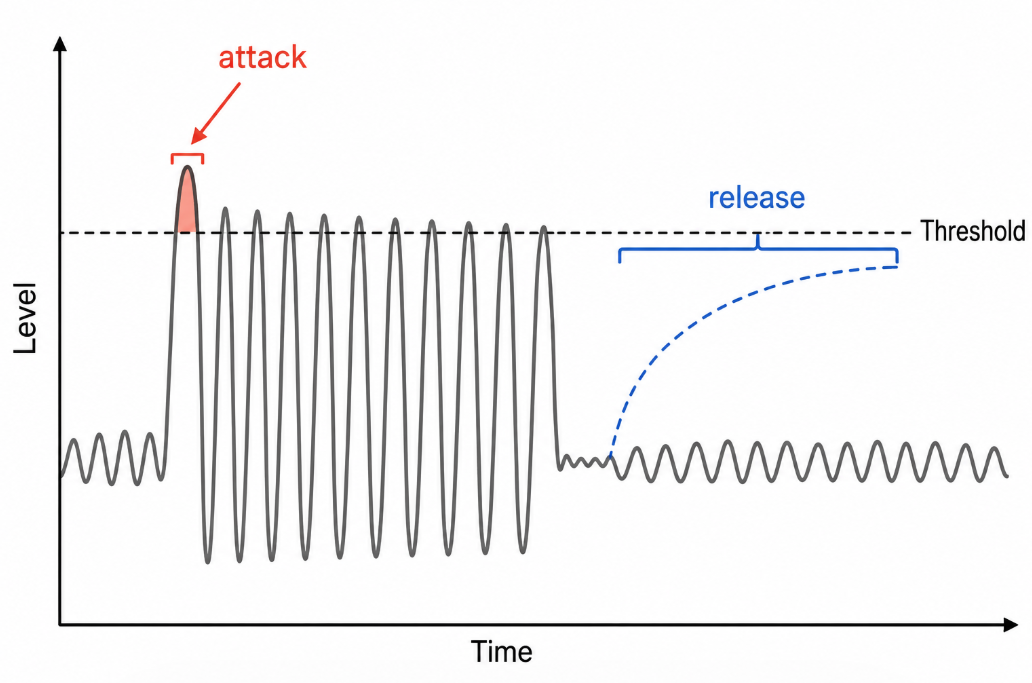
Attack determines how much of the first peak escapes; release determines how quickly normal gain returns.
Sizing a Speaker-Protection Limiter: The Practical Math
For audio systems, the most common real task is setting a limiter to protect a loudspeaker. The widely used approach, documented in Linea Research's limiter setup application note, works from the speaker's power rating and impedance:
V_RMS = √(Power × Impedance)
A 600 W continuous rating into 8 Ω corresponds to about 69 V RMS at the amplifier output. Two conversions come up constantly in this work: multiply an RMS voltage by 1.414 to get the peak value, and multiply a peak value by 0.707 to get back to RMS. Mixing these up is one of the most common ways limiter thresholds end up wrong by 3 dB.
One more step trips people up: if your limiter sits before the power amplifier (the usual case in DSP processors), you must subtract the amplifier's voltage gain from the calculation. A threshold computed at the speaker terminals means nothing until you translate it back through the amp's gain to the limiter's actual position in the chain. Amplifier gain varies by model and sometimes by gain switch setting, so verify it from the amplifier's own documentation rather than assuming a typical figure.
Finally, remember what a power rating is: a thermal figure derived from standardized test signals. A limiter set exactly at the rated power protects the voice coil thermally but does not guarantee protection against mechanical over-excursion at low frequencies. Many system designs use separate peak and RMS limiters for this reason.
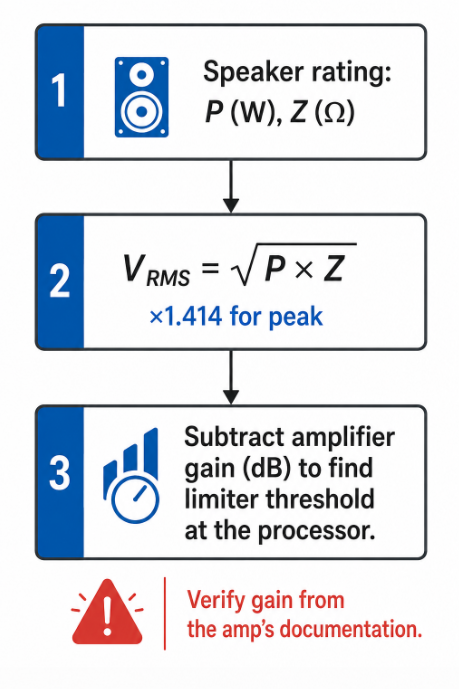
Threshold setting in three steps: speaker spec → voltage → account for amplifier gain.
Where Limiter Circuits Are Used
Loudspeaker and amplifier protection. Limiters prevent amplifier clipping from reaching drivers and keep long-term output inside the speaker's thermal rating. Clipping is particularly dangerous for tweeters, which receive far more high-frequency energy from a squared-off waveform than from clean program material.
Power supplies and bench equipment. Active current limiting protects regulators, pass transistors, and the device under test when something shorts. Unlike a fuse, the circuit recovers on its own once the fault clears.
FM receivers. An amplitude limiter stage in the IF chain strips amplitude variations (noise, fading) from the signal before demodulation — in FM, the information lives in frequency, so amplitude can be sacrificed for noise immunity.
RF front-end protection. Limiters placed ahead of low-noise amplifiers protect them from strong nearby transmitters or pulses that would otherwise destroy the input stage.
Broadcast compliance. Transmission chains use limiters to prevent over-modulation, which regulators restrict because it interferes with adjacent channels.
Automotive electronics. Vehicle power buses experience load-dump and other transients; voltage limiting protects ECUs and downstream electronics. Automotive use typically also involves dedicated transient suppression components qualified for that environment, not signal limiters alone.
LED drivers. A constant-current limiter prevents thermal runaway in LEDs, which conduct progressively more current as they heat up at a fixed voltage.
Bench repair work. A classic external limiter for servicing linear and tube amplifiers is the dim-bulb tester: an incandescent bulb (commonly 100–250 W) wired in series with the mains feed. If the device under repair has a short, the bulb lights up and absorbs the fault energy instead of the amplifier's components. Note that this involves mains wiring — build and use one only if you are qualified to work safely with line voltage.
Application Boundaries: What a Limiter Cannot Do
A limiter is not a fuse. During a sustained fault, an active current limiter forces the pass element to dissipate the fault power continuously. Without adequate heatsinking or a foldback/shutdown mechanism, the limiter survives the fault and then dies from the heat.
A clipper is not an audio limiter. Diode clipping protects hardware but produces heavy distortion. If sound quality matters, you need gain-based limiting, not waveform clipping.
An audio limiter does not fix a undersized system. If a limiter is engaged constantly, the amplifier or speakers are wrong for the job. Limiters are for peaks and accidents, not steady-state operation.
Threshold accuracy has physical limits. Diode and V_BE-based thresholds drift with temperature. If you need a precise, stable ceiling, use a reference-and-comparator architecture instead of relying on junction voltages.
One limiter rarely covers both thermal and excursion protection in loudspeakers. Verify whether your use case needs separate RMS and peak limiting.
Common Mistakes
Confusing RMS and peak values. A spec sheet gives RMS; a scope shows peaks. Convert deliberately (×1.414 / ×0.707) and state which one every number is.
Ignoring amplifier gain when the limiter sits upstream. The threshold must be referred to the limiter's position in the chain, not the speaker terminals.
Undersizing the pass transistor's fault dissipation. Compute the worst case: full supply voltage across the transistor at full limit current, sustained.
Choosing attack time by guesswork. Too slow lets destructive transients through; too fast causes distortion on low-frequency content. Tune against the actual program material and protection target.
Treating a simulation as verification. Simulate first, but confirm threshold and recovery behavior on the bench with a current-limited supply and a dummy load before connecting real speakers or expensive loads.
Assuming any published circuit's component values transfer to your supply rails and load. Re-derive thresholds and dissipation for your actual operating conditions.
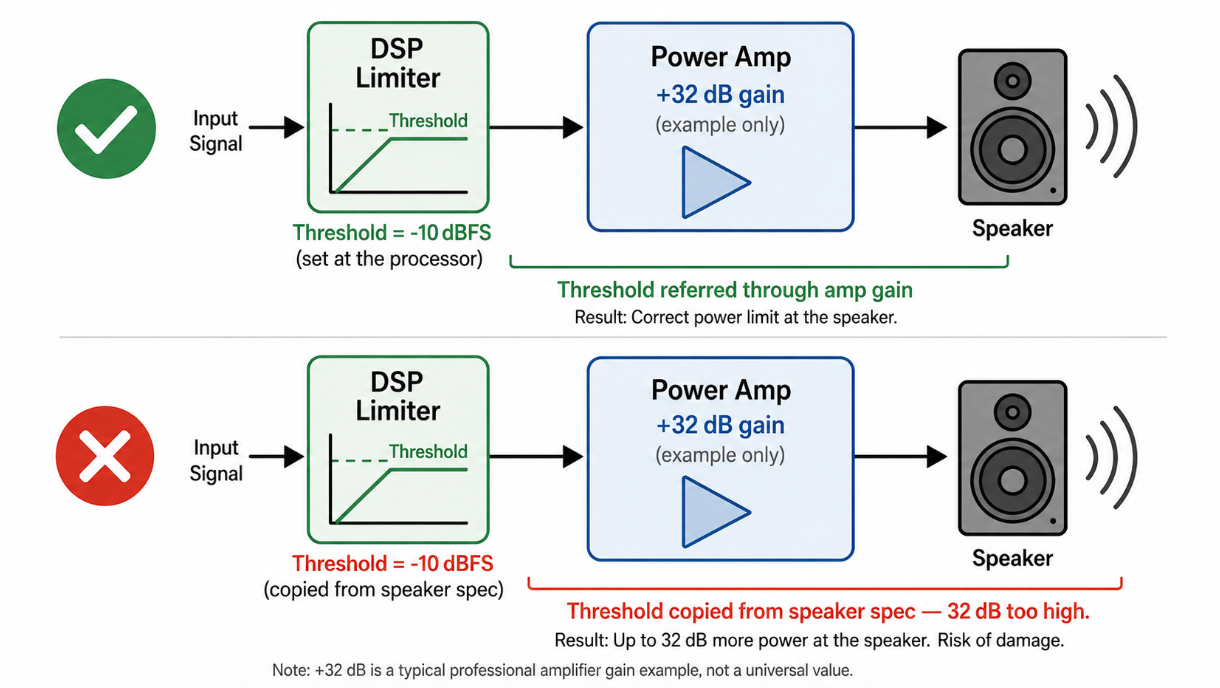
The same threshold number means different things at different points in the signal chain.
Sourcing and Verification Notes
If you are buying limiter ICs, audio VCA chips, Zeners, sense resistors, or pass transistors for a limiter build, a few procurement realities matter:
Check lifecycle status before designing in a part. Some classic analog limiter and VCA ICs have long histories, and availability changes. Confirm active/NRND/EOL status with the manufacturer or an authorized distributor before committing a design.
Specialty analog ICs are counterfeit targets. For parts like audio VCAs, buy through authorized channels or require traceability documentation.
"Equivalent" does not mean "drop-in." A parametrically similar op-amp or transistor may differ in recovery time, SOA, or thermal behavior — exactly the parameters limiters stress. Treat alternatives as candidates to verify, not guaranteed replacements.
Sense resistors are precision components here. Tolerance and temperature coefficient on R_sense translate directly into threshold error. Budget for a quality part, not a generic chip resistor.
Datasheet Verification Checklist
Before finalizing a limiter design, confirm each of these from current official datasheets — not from forum posts, old PDFs, or AI summaries:
Zener voltage tolerance and temperature coefficient at your operating current
Pass transistor safe operating area (SOA) at fault voltage and limit current
Op-amp output recovery behavior after clamping (overload recovery time)
VCA/limiter IC supply range, control law, and distortion specs at your levels
Sense resistor power rating at limit current (P = I² × R), with margin
Thermal resistance and required heatsinking for sustained fault conditions
Lifecycle status (active / NRND / EOL) of every IC in the design
Package and pinout against your actual footprint, not a lookalike part
FAQ
What is the difference between a limiter and a compressor?
Both reduce gain above a threshold. A compressor uses moderate ratios to shape dynamics; a limiter uses very high ratios — commonly described as roughly 10:1 and up — to enforce a ceiling. Functionally, a limiter is a compressor configured to say "no" rather than "less."
How do I build a simple current limiter circuit?
The minimal version is a pass transistor, a sense resistor in series with the load, and a second small transistor from the sense resistor to the pass transistor's base. Current is capped near 0.7 V divided by the sense resistance. It works, but verify the pass transistor's dissipation under a sustained short before trusting it.
Can I make the current limit adjustable?
Yes. Replace the fixed V_BE threshold with a comparator or op-amp referencing an adjustable voltage (from a potentiometer or DAC) against the sense-resistor drop, driving the pass element. This also removes most of the temperature drift of the simple two-transistor version.
Should I use a MOSFET or a BJT for the pass element?
MOSFETs dominate at higher currents because of low on-resistance and easier paralleling, but check the SOA curve for linear operation — many modern switching MOSFETs have poor linear-mode SOA, which is exactly the region a current limiter operates in. BJTs remain common in simple linear limiters.
Does a limiter protect speakers completely?
No single limiter does. An RMS limiter addresses thermal damage; a peak limiter addresses excursion. High-frequency drivers are also vulnerable to spectral changes from upstream clipping. System-level protection usually combines both limiter types plus sensible gain structure.
Where does the limiter go in an audio signal chain?
For loudspeaker protection, in the DSP or processor immediately before the power amplifier, with the threshold referred through the amplifier's gain. For mastering, it is the final stage before the output. For RF, directly ahead of the stage being protected.
Sources and references used for this guide
Setting Up Limiters — Linea Research application note Source type: Independent professional application note Used for: Speaker-protection limiter threshold methodology, V = √(P × Z), RMS/peak conversion factors, accounting for amplifier gain.
AN-20: An Applications Guide for Op Amps — Texas InstrumentsSource type: Manufacturer application note Used for: Op-amp feedback techniques underlying precision limiter stages and current-sensing configurations.
Amplifier Applications Guide — Analog DevicesSource type: Manufacturer design handbook Used for: Background on amplifier protection, audio op-amp application practice, and signal-chain design context.
DN03: Signal Limiter for Power Amplifiers — THAT CorporationSource type: Vendor design note Used for: Architecture of a single-chip VCA + RMS-detector feedback limiter for power amplifiers.
Community discussions on current-limiting circuits (e.g., All About Circuits forum threads) Source type: Community discussion Used for: Understanding common builder questions and failure modes around simple current limiters; used for topic discovery only, not as factual authority.
 UTMEL
UTMEL
We are the professional distributor of electronic components, providing a large variety of products to save you a lot of time, effort, and cost with our efficient self-customized service. careful order preparation fast delivery service
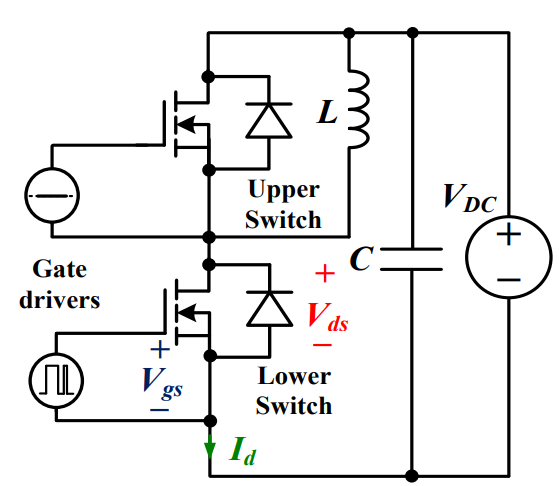 Discovering New and Advanced Methodology for Determining the Dynamic Characterization of Wide Bandgap DevicesSaumitra Jagdale15 March 20242815
For a long era, silicon has stood out as the primary material for fabricating electronic devices due to its affordability, moderate efficiency, and performance capabilities. Despite its widespread use, silicon faces several limitations that render it unsuitable for applications involving high power and elevated temperatures. As technological advancements continue and the industry demands enhanced efficiency from devices, these limitations become increasingly vivid. In the quest for electronic devices that are more potent, efficient, and compact, wide bandgap materials are emerging as a dominant player. Their superiority over silicon in crucial aspects such as efficiency, higher junction temperatures, power density, thinner drift regions, and faster switching speeds positions them as the preferred materials for the future of power electronics.
Read More Applications of FPGAs in Artificial Intelligence: A Comprehensive GuideUTMEL29 August 20255432
This comprehensive guide explores FPGAs as powerful AI accelerators that offer distinct advantages over traditional GPUs and CPUs. FPGAs provide reconfigurable hardware that can be customized for specific AI workloads, delivering superior energy efficiency, ultra-low latency, and deterministic performance—particularly valuable for edge AI applications. While GPUs excel at parallel processing for training, FPGAs shine in inference tasks through their adaptability and power optimization. The document covers practical implementation challenges, including development complexity and resource constraints, while highlighting solutions like High-Level Synthesis tools and vendor-specific AI development suites from Intel and AMD/Xilinx. Real-world applications span telecommunications, healthcare, autonomous vehicles, and financial services, demonstrating FPGAs' versatility in mission-critical systems requiring real-time processing and minimal power consumption.
Read More The 2026 Engineer’s Guide: Choosing the Right MCU for Your Next IoT & New Energy ProjectUTMEL30 April 20261556
A comprehensive comparison of 2026's leading MCUs from ST, NXP, and Microchip across power efficiency, processing performance, connectivity, and ecosystems to help engineers select the optimal chip for next-gen IoT and new energy projects.
Read More AI Server Components: Engineering Next-Gen Data Center Hardware for 100kW RacksUTMEL15 May 2026855
The transition from traditional enterprise IT to AI-driven workloads has rendered legacy data center hardware obsolete, forcing infrastructure planners to re-engineer server components for extreme thermal environments.
Read More The Practical Engineer’s Guide to the NE555N Timer: Pinout, Setup, and TroubleshootingUTMEL29 May 2026632
This comprehensive guide explores the NE555N timer, detailing its 8-pin layout, internal architecture, and key datasheet specifications. It compares the bipolar IC to CMOS variants and details setup configurations for astable, monostable, and bistable modes. Additionally, the guide offers practical troubleshooting advice to prevent common breadboard failures, such as floating reset pins and electrical noise issues.
Read More
Subscribe to Utmel !
![MOC3061SR2VM]() MOC3061SR2VM
MOC3061SR2VMON Semiconductor
![MOC3061SVM]() MOC3061SVM
MOC3061SVMON Semiconductor
![ATECC608A-SSHCZ-T]() ATECC608A-SSHCZ-T
ATECC608A-SSHCZ-TMicrochip Technology
![FOD420S]() FOD420S
FOD420SON Semiconductor
![DLPA1000YFFT]() DLPA1000YFFT
DLPA1000YFFTTexas Instruments
![HCS201/P]() HCS201/P
HCS201/PMicrochip Technology
![AT88SC0404CA-TH]() AT88SC0404CA-TH
AT88SC0404CA-THMicrochip Technology
![DLPC300ZVB]() DLPC300ZVB
DLPC300ZVBTexas Instruments
![FOD4118SV]() FOD4118SV
FOD4118SVON Semiconductor
![MOC3051VM]() MOC3051VM
MOC3051VMON Semiconductor


